It is called a national health care system. But Canada does not actually have one single national health service.
If you are new to Canada, the health care system can seem surprisingly difficult to understand.
You hear that Canada has “universal health care.” You receive a provincial health card. You can see a doctor or go to hospital without receiving the kind of bill patients might receive in some other countries.
But then you discover that your prescription medicine may not be fully covered. Dental care may not be covered. An ambulance may come with a charge. Finding a family doctor can be difficult. And the rules can change when you cross a provincial border.
All of those things can be true at the same time.
The easiest way to understand the Canadian system is to start with one important fact:
Canada does not operate one national health service. It has 13 provincial and territorial health insurance systems connected by a common federal framework.
Provincial and territorial governments have primary responsibility for organizing and delivering health care. The federal government sets important national conditions through the Canada Health Act, contributes funding, regulates areas such as drugs and health products, coordinates certain national health functions, and provides or supports services for some specific populations. That distinction explains a lot about how Canadian health care works.
                     PEOPLE IN CANADA
                           │
                           │ taxes
                           ▼
          ┌────────────────────────────────┐
          │        GOVERNMENTS             │
          │                                │
          │ Federal     Provinces/Territories
          └─────┬───────────────┬──────────┘
                │               │
    Canada Health Act       Run health systems
    + federal funding       + insurance plans
                │               │
                └──────┬────────┘
                       ▼
          PROVINCIAL/TERRITORIAL
             HEALTH INSURANCE
                       │
          ┌────────────┴─────────────┐
          ▼                          ▼
      Hospitals                  Physicians /
      & services               health providers
          │                          │
          └────────────┬─────────────┘
                       ▼
                     PATIENT
             medically necessary
              insured health care
The important idea is that the federal government generally does not run your local hospital or family doctor’s office. Provinces and territories organize their own systems, within a national framework.
First: what does “universal health care” actually mean?
Canada’s public health insurance system is commonly called Medicare.
At its core, Medicare protects eligible residents from having to pay at the point of care for medically necessary hospital and physician services, plus certain surgical-dental procedures that must be performed in a hospital.
That sentence is important because “universal health care” does not mean:
Every health-related service is free for every person.
It means that provincial and territorial insurance plans must meet federal requirements for a defined core of insured health services.
Even the term medically necessary is not defined as a detailed national list in the Canada Health Act. Provinces and territories determine which services qualify, generally in consultation with the medical profession.
The five rules behind Canadian Medicare
The Canada Health Act establishes five criteria provincial and territorial insurance plans must satisfy to receive their full federal cash contribution through the Canada Health Transfer.
| Canada Health Act principle | For our understanding |
|---|---|
| Public administration | The provincial/territorial insurance plan must be administered by a public authority on a non-profit basis. |
| Comprehensiveness | The plan must cover insured hospital, physician and qualifying surgical-dental services. |
| Universality | Eligible insured residents must be covered on uniform terms and conditions. |
| Portability | Coverage has protections when residents move or are temporarily outside their home province. |
| Accessibility | Insured residents should have reasonable access to insured services without financial barriers such as patient charges. |
There are also requirements relating to information and recognition of federal contributions, as well as restrictions on extra-billing and user charges for insured services.
But there is an important nuance hidden inside the first principle.
Publicly funded does not necessarily mean publicly delivered.
The Canada Health Act requires the insurance plan to be publicly administered.
It does not require every doctor, clinic or facility providing publicly insured care to be government owned. Private practitioners or facilities can provide insured services as long as the arrangements comply with the applicable rules and patients are not charged for insured services in ways prohibited by the Act.
So who is responsible for what?
A simplified version looks like this.
Federal government
The federal government establishes national requirements for provincial and territorial insurance plans through the Canada Health Act and provides substantial funding through the Canada Health Transfer.
For 2026–27, the Canada Health Transfer is set at approximately $57.4 billion.
The federal government also has responsibilities involving drug and product regulation, public health, health research and emergency preparedness, and it delivers or supports health services for certain populations and programs.
Provinces and territories
This is where most of what we normally think of as “the health care system” is organized.
Provinces and territories:
- administer their health insurance plans;
- determine budgets and priorities;
- organize hospitals and health authorities;
- regulate health professionals through provincial frameworks;
- determine many coverage rules;
- operate drug and other supplementary benefit programs;
- and organize much of primary, specialist, hospital and community care.
That is why a person living in British Columbia may encounter somewhat different programs, structures or coverage rules from someone living in Ontario, Quebec or Nova Scotia.
What happens when you need health care?
This is probably the easiest way to understand the system.
Imagine you wake up one morning with persistent abdominal pain.
Route 1: Primary care
You might first contact a:
family physician → nurse practitioner → primary-care clinic → walk-in/urgent-care service
Primary-care providers diagnose and manage many conditions themselves. They also commonly act as the connection to specialist services when those are needed.
If the service is an insured medically necessary physician service and you are covered by the provincial/territorial plan, you generally do not pay the physician directly at the visit.
Route 2: Specialist care
If further investigation is required, your primary-care provider may refer you to a specialist.
For example:
Primary care → gastroenterologist → diagnostic testing → treatment
The precise referral pathways vary by service and jurisdiction.
Route 3: Hospital care
If you require medically necessary hospital treatment, insured hospital services are part of the core Medicare entitlement.
Route 4: Emergency care
For an emergency, you can go directly to an emergency department.
Emergency departments do not simply operate on a first-come, first-served principle. Patients are triaged according to clinical urgency.
So why don’t I receive a bill?
Because “no bill at the doctor’s office” is different from “health care costs nothing.”
Canadian health care is largely prepaid collectively through taxation.
Governments collect revenue through various taxes and other sources and use public funds to finance health services.
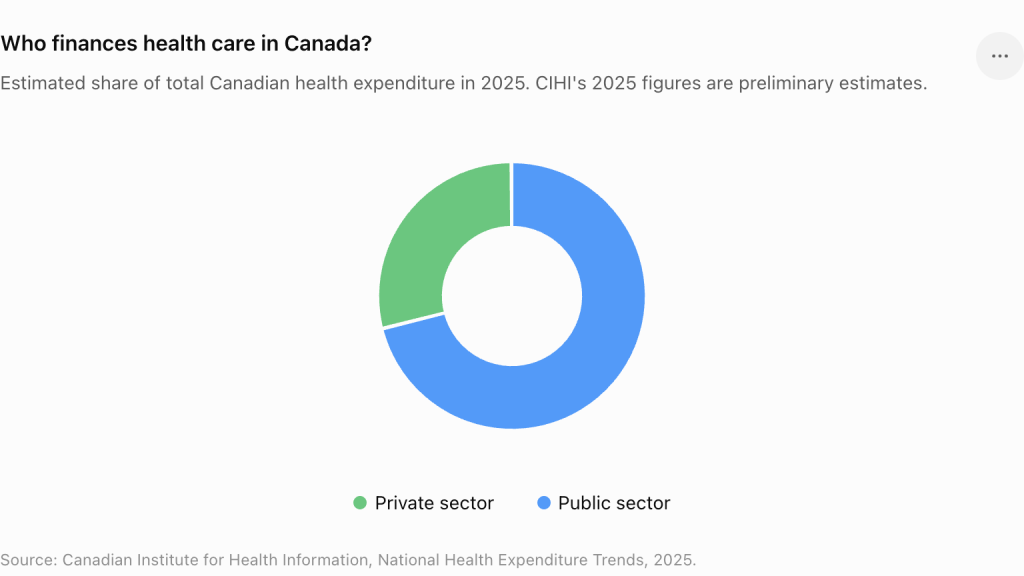
The latest comprehensive CIHI estimates put Canada’s total health expenditure in 2025 at about $398.8 billion, or approximately $9,626 per person. Health expenditure represented an estimated 12.7% of GDP.
About 71.2% of total health expenditure was estimated to come from public-sector sources and 28.8% from private-sector sources. Private spending includes, among other things, household out-of-pocket spending and private insurance.
Where health-care money comes from
So a more accurate sentence than “health care is free in Canada” would be:
Core insured health services are publicly financed, and eligible patients generally do not pay a charge at the point of service for those insured services.
What does Medicare pay for – and what may still cost you money?
This is probably the part of Canadian health care that causes the most confusion.
Core Medicare coverage
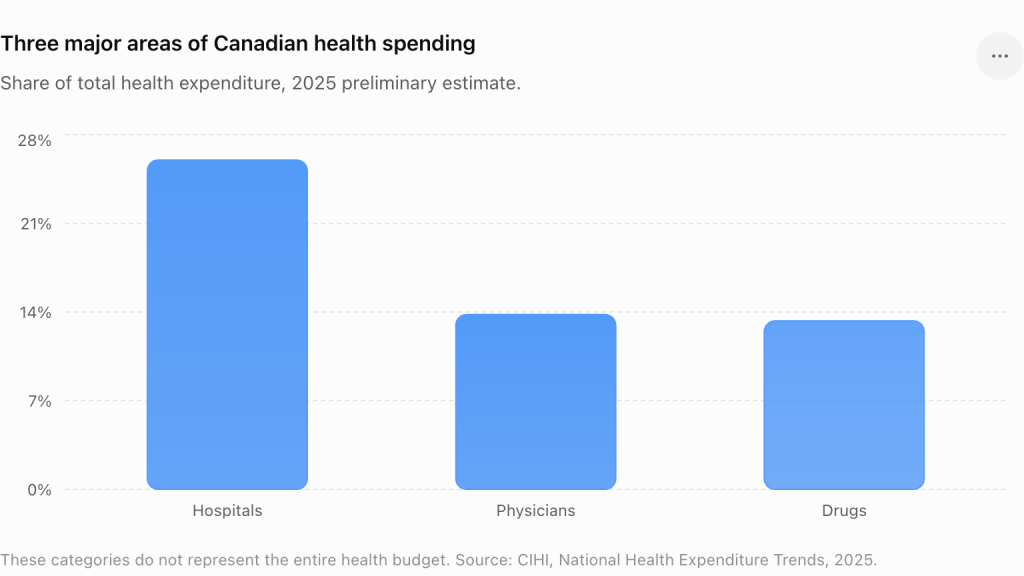
Across provinces and territories, the Canada Health Act protects coverage for:
Medically necessary hospital services
Medically necessary physician services
Certain surgical-dental procedures that require a hospital setting
But services outside this core can be very different.
| Service | Public coverage |
|---|---|
| Medically necessary hospital care | Core insured service |
| Medically necessary physician care | Core insured service |
| Outpatient prescription drugs | Varies by jurisdiction/program |
| Routine dental care | Not part of core Medicare; other public programs may apply |
| Routine vision care | Coverage varies |
| Ambulance | Coverage/charges vary |
| Home care | Coverage varies |
| Long-term care | Publicly supported, but rules and patient contributions vary |
| Physiotherapy outside hospital | Varies |
| Psychotherapy/counselling outside insured physician care | Coverage varies substantially |
| Cosmetic procedures | Generally not publicly insured when not medically necessary |
Health Canada specifically identifies prescription drugs, dental care, vision care, ambulance and home care as examples of services for which provincial and territorial governments may provide additional coverage, often targeted to particular populations. Others may rely on employment-based insurance, individually purchased insurance or out-of-pocket payment.
This is one reason Canada can simultaneously have universal Medicare and a substantial private health-insurance market.
One more distinction: health care is not the same thing as public health
Because I work in public health, I think this distinction is worth making.
Health care largely focuses on services provided to individuals: diagnosing illness, seeing a physician, receiving surgery, getting treatment.
Public health works primarily at the population level: preventing disease, surveillance, vaccination programs, health promotion, outbreak management, injury prevention and preparedness for public-health emergencies.
The Public Health Agency of Canada has national roles in health promotion, infectious- and chronic-disease prevention and control, and emergency preparedness. Provinces, territories, regional health authorities and local public-health organizations also play substantial roles in delivering public-health programs.
The two systems overlap constantly, but they are not interchangeable.
Five misconceptions worth clearing up
“Canada has one health-care system.”
Not exactly. There are 13 provincial and territorial systems operating within a federal framework.
“Health care is free.”
It is largely financed through taxation. Eligible patients generally do not face a direct charge for insured hospital and physician services at the point of care.
“Everything health-related is covered.”
No. Coverage outside core hospital and physician services varies considerably.
“Public health care means all doctors and hospitals are government-run.”
No. Public financing and public insurance can coexist with independent or private delivery of services.
“Universal coverage means equal or immediate access.”
No. Insurance coverage establishes financial entitlement to insured services; actual availability and waiting time can still differ by service and location.
Those distinctions are not merely technical. They are the key to understanding most debates about Canadian health care.
The simplest way I understand the Canadian system
Canada essentially makes a collective commitment that your ability to obtain medically necessary hospital and physician care should not depend on whether you can afford the bill at the moment you become sick.
It accomplishes that through publicly financed provincial and territorial insurance plans operating within national rules.
But around that protected core sits a much more complicated health system: prescription drugs, dentistry, mental health care, home care, long-term care, rehabilitation, private insurance, public-health programs and numerous federal and provincial initiatives.
So perhaps the most accurate description is not:
“Canada has free health care.”
It is:
Canada has universal public insurance for a core set of medically necessary health services, delivered through decentralized provincial and territorial health systems and supplemented by other public programs, private insurance and out-of-pocket spending.
Once you understand that sentence, much of the apparent contradiction in Canada’s health-care system begins to make sense.


Leave a comment